ADHD and Burnout: When Holding It All Together Stops Working
You have spent years building systems, pushing through, and performing a version of yourself that the world accepts. But what happens when the strategies that kept you afloat start to sink you?

You have spent years building systems, pushing through, and performing a version of yourself that the world accepts. But what happens when the strategies that kept you afloat start to sink you?
There is a particular kind of exhaustion that adults with ADHD know well. It is not the tiredness that comes from a long day. It is the tiredness that comes from a long life of working harder than everyone around you just to keep up.
You have built workarounds for everything. You have developed routines, scripts, backup plans. You have learned to mask so effectively that most people have no idea how much effort goes into what you do.
From the outside, you look capable. You look like someone who has it together. But inside, the machinery is overheating. And when it finally stalls, it does not look like what most people think burnout looks like.
What ADHD Burnout Actually Is
Burnout, in a general sense, describes a state of chronic physical and emotional exhaustion, usually accompanied by a sense of detachment and a loss of effectiveness. The World Health Organization classifies it as an occupational phenomenon, though most people experience it beyond the boundaries of work.
ADHD burnout shares some of those features but carries additional layers. It is not only the result of doing too much. It is the result of doing too much while also managing the invisible labour of having a brain that operates outside the expected norm.
That invisible labour includes: masking symptoms so that other people feel comfortable, translating between how your brain works and how the world expects you to operate, compensating for executive function challenges through sheer willpower, managing the constant background noise of self-monitoring (did I forget something, am I talking too much, am I being normal enough), and recovering from the sensory and emotional overload that comes with all of the above.
None of that shows up in a time sheet or a to-do list. But it consumes enormous amounts of energy every single day. When the reserves finally run out, the collapse can feel sudden from the outside, even though it has been building for months or years.
How ADHD Burnout Shows Up
ADHD burnout does not always look like what people expect. It is not necessarily lying in bed unable to move (although it can be). Often, it looks like this:
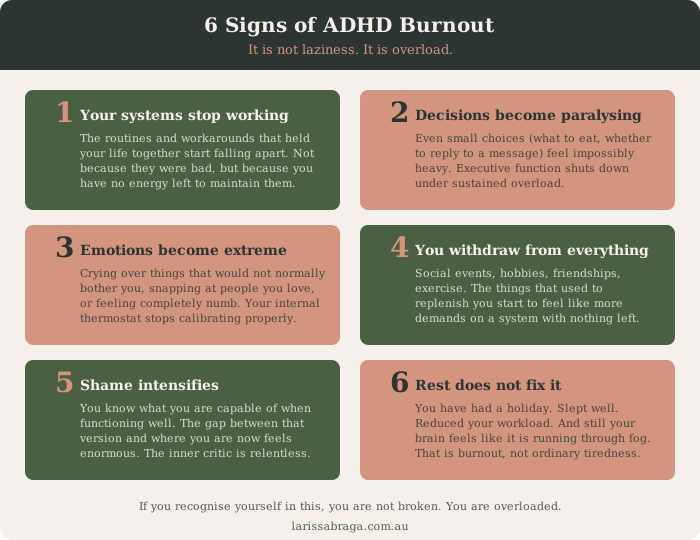
Your coping strategies stop working. The systems, routines, and workarounds that held your life together start falling apart. Not because they were bad systems, but because you no longer have the energy to maintain them.
Decision-making becomes paralysing. Even small choices (what to eat, whether to reply to a message, which task to start) feel impossibly heavy. This is executive function shutting down under sustained overload.
Emotional regulation deteriorates. You find yourself crying over things that would not normally bother you, snapping at people you love, or feeling completely numb. The internal thermostat that helps you regulate your responses stops calibrating properly.
You withdraw. Social events, hobbies, friendships, exercise, the things that used to replenish you, start to feel like more demands on a system that has nothing left to give. So you cancel, avoid, or simply go quiet.
Shame intensifies. Because you know what you are capable of when you are functioning well, the gap between that version of yourself and where you are now feels enormous. The internal narrative becomes relentless: what is wrong with me, why can I not just do this, everyone else manages.
If you recognise yourself in this, please read the next section carefully.
Why This Is Not Laziness, Weakness, or Failure
This is one of the most important things I can tell you: ADHD burnout is not a character flaw. It is the predictable consequence of sustained overcompensation in a world that was not designed for your brain.
Think about it this way. If you have been running a machine at 150% capacity for years because that is what it takes to match the output of machines running at 80%, eventually that machine overheats. That is not a design flaw. That is physics.
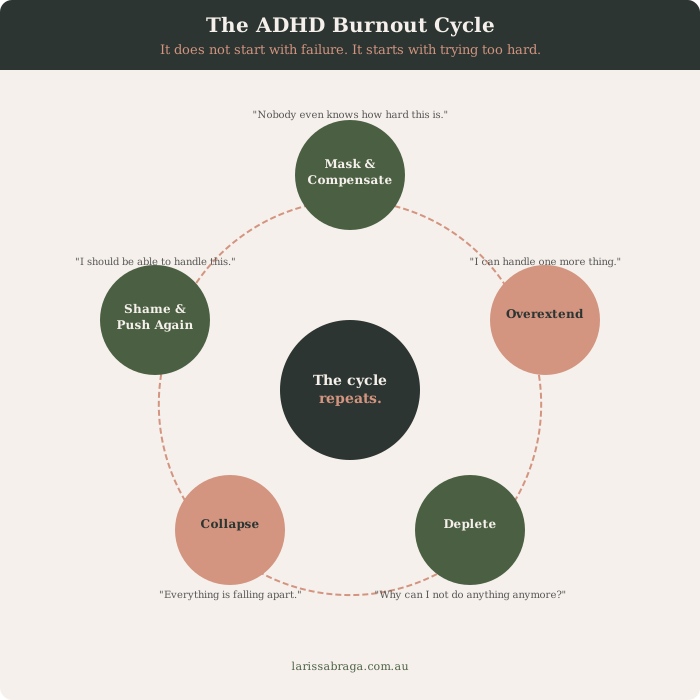
The shame you feel about burning out is itself part of the cycle. You burn out because you pushed too hard. You feel ashamed because you think you should be able to push harder. The shame drives you to push again before you have recovered. And the cycle deepens.
Breaking that cycle requires something that most adults with ADHD find genuinely difficult: permission to stop performing.
ADHD Burnout, Depression, or Both?
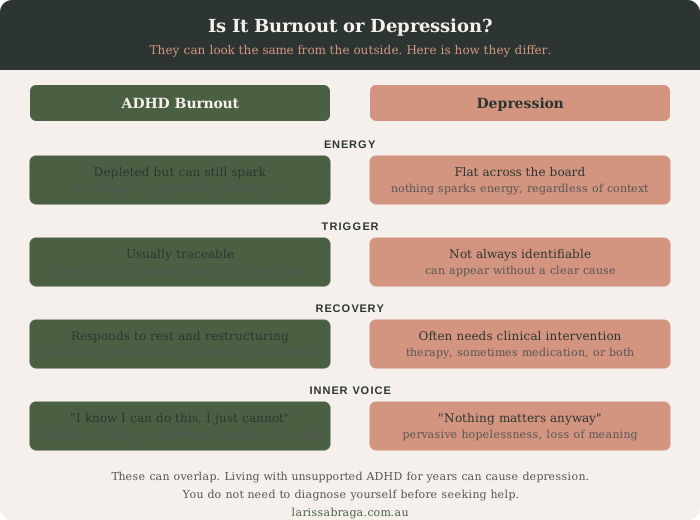
Burnout and depression can look almost identical from the outside: low energy, withdrawal, difficulty concentrating, loss of motivation. When ADHD is in the mix, untangling what is what becomes even harder.
A few distinctions that can help (though they are not always clean):
Burnout tends to be context-dependent. You might feel completely depleted at work but still spark to life around something that genuinely interests you. Depression tends to flatten everything, regardless of context.
Burnout often comes with a clear trajectory. You can usually trace it back: the workload increased, or a major life change happened, or you took on too many responsibilities at once. Depression does not always have an identifiable trigger.
Recovery paths differ. Burnout responds to rest, boundary-setting, and structural change. Depression often requires clinical intervention, sometimes medication, sometimes therapy, usually both.
The complicating factor with ADHD is that living with undiagnosed or unsupported ADHD for years can cause depression. Not as a separate condition, but as a direct result of chronic stress, repeated failure experiences, and internalised shame. In those cases, treating the burnout and the ADHD together is essential, because the depression will not lift until its root cause is addressed.
If you are unsure what you are dealing with, a thorough assessment with someone who understands ADHD is the best starting point. You do not need to diagnose yourself before seeking help.
What Recovery From ADHD Burnout Actually Looks Like
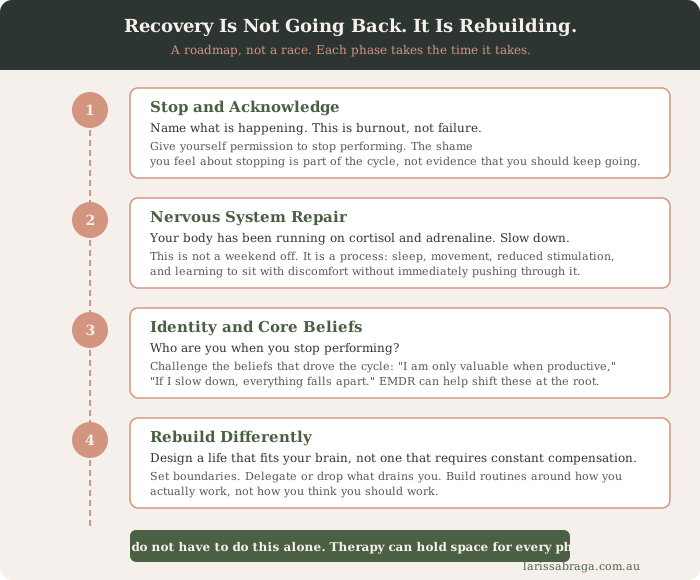
Recovery is not about going back to the way things were. If the way things were is what burned you out, returning to that baseline is just a countdown to the next crash.
Recovery means rebuilding differently. It means designing a life that accounts for how your brain actually works, rather than one that requires constant compensation to function within.
That process usually involves several things:
Radical honesty about what is sustainable. This means looking at your commitments, your routines, your relationships, and your work, and asking: which of these require me to mask, overperform, or push past my limits just to maintain? And what would it look like to change that?
Nervous system repair. Your body has been running on cortisol and adrenaline. Recovery involves slowing down enough for your nervous system to come back to baseline. This is not a weekend. It is a process, and it takes time.
Identity work. If you have spent your whole life defining yourself by your output, by how much you can handle, by how well you perform under pressure, then burnout is also an identity crisis. Who are you when you stop performing? That question deserves space, and it deserves a compassionate witness.
Practical restructuring. Once the emotional and physical layers are addressed, there is real practical work to do. What boundaries need to be set? What tasks can be delegated, dropped, or simplified? What accommodations would help? How does your daily routine need to change?
Where Therapy Fits Into Recovery
You cannot think your way out of burnout. You cannot optimise your way out of it with another app or another morning routine. Burnout that runs this deep needs a different kind of support.
In my practice, I work with adults who are navigating the overlap of ADHD and burnout using a combination of ADHD-informed counselling and EMDR therapy.
Counselling provides a consistent space to slow down, identify the patterns that led here, and begin rebuilding from a more grounded place. It is not about giving you more strategies to pile on top of what already was not working. It is about understanding what happened, why it happened, and what needs to change at the root.
EMDR can address the core beliefs that keep the cycle going: “I am only valuable when I am productive,” “If I slow down, everything will fall apart,” “I do not deserve rest.” These beliefs often trace back to early experiences and they operate below conscious awareness. EMDR helps shift them at the level where they were formed.
I see clients in person in Billinudgel (Northern Rivers, NSW) and via telehealth across Australia. Sessions are available in English and Portuguese.
Frequently Asked Questions
How do I know if I have ADHD burnout or if I am just tired?
Regular tiredness recovers with rest. ADHD burnout does not. If you have had a holiday, slept well, reduced your workload, and still feel like your brain is running through fog, that is a signal worth paying attention to. The distinguishing feature is usually duration and depth: burnout persists even when the external pressures ease, because the internal pressures (masking, compensating, self-monitoring) continue.
Can you burn out even if you love your work?
Absolutely. Passion does not protect you from overextension. In fact, for people with ADHD, hyperfocus on meaningful work can accelerate burnout because you lose track of your own limits. You forget to eat, sleep poorly, skip exercise, and push through signals that your body is sending. Loving what you do makes it harder to stop, not easier.
Is ADHD burnout recognised as a clinical condition?
Not formally, no. “ADHD burnout” is a descriptive term used within the ADHD community and by clinicians who specialise in neurodivergence. It captures a pattern that standard burnout frameworks do not fully account for: the additional cognitive and emotional load of managing ADHD itself. While it is not a diagnosis, the experience is clinically significant and treatable.
You Do Not Have to Keep Pushing Through
If you have been running on empty for longer than you can remember, and you are ready for something to change, I would be glad to work with you.
I offer ADHD-informed counselling and EMDR therapy, in person in the Northern Rivers (Billinudgel, NSW) and via telehealth across Australia. Sessions are available in English and Portuguese.
Larissa Braga is a counsellor and EMDR therapist based in the Northern Rivers, NSW. She specialises in ADHD-informed counselling, trauma therapy, and support for adults navigating neurodivergence. She works in English and Portuguese, in person